
April 22, 2026
Lisa G. Dill
When you set out to write a book about a river, you realize quickly that you are going to have to make some tough choices or you could easily write a thousand pages. When the river you’ve chosen to write about is the Missouri—2,300 miles long, parts of it nearly 50 million years old, and part of human history for almost 15,000 years—those choices become even harder.
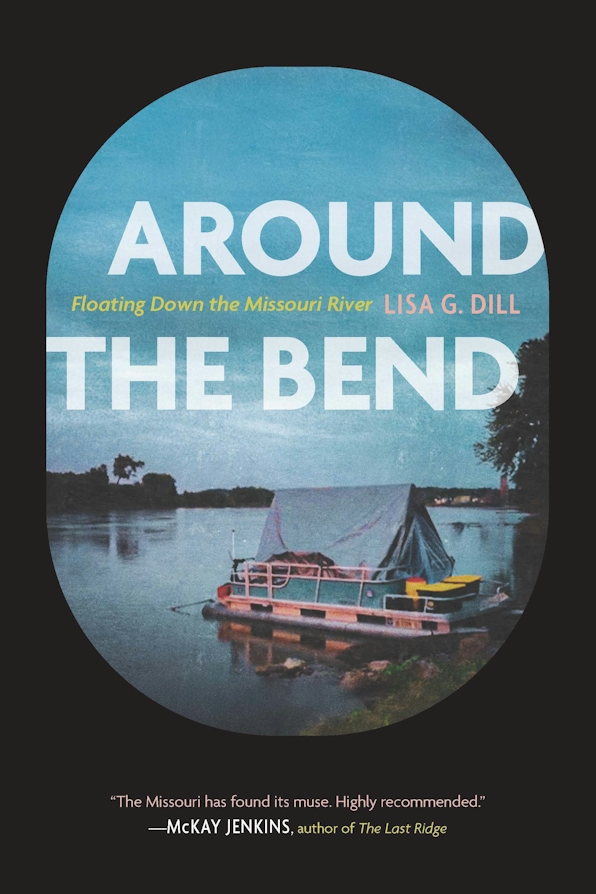
In 2013, four of my mother’s first cousins and I sailed a forty-year-old pontoon boat 730 miles down the Missouri from Sioux City, Iowa to St. Louis, Missouri. Over two weeks on the river, we came into close contact with a lot of the river’s human history: traces of the Corps of Discovery (most obviously, the Sgt. Floyd memorial, and the confluence of the river the men named in his honor), the Iowa Tribe of Kansas and Nebraska, whose tribal land stands over the Missouri, restored frontier military outposts, Civil War battlefields. We saw evidence of nearly a century of engineering work, trying to manage a river that has always been resistant to human controls. We saw the USS Meriwether Lewis, one of the Corps of Engineers’ workboats, and the Arabia, in a museum in Kansas City, where they are restoring and displaying the contents of a steamboat that hit a snag in the river and sank in 1856.

Around the Bend, the book I wrote (published this month by the University of Nebraska Press), takes on most of these topics, along with the wildlife, weather, and efforts to govern the river. I took full advantage of the comic misadventure of the trip—while I would do it again in a second, a forty-year-old pontoon boat is perhaps not the ideal choice for a trip down the longest river on the continent—to string these ideas together. But at its heart, the book is about the river itself.
The book required almost-literal mountains of research, and more than once I got a gift from what I started referring to as the “book gods,” some accidental find I hadn’t expected or really been looking for but that cracked open some way to connect the reader to the material. I read books, and scientific journal articles, and government reports. I met with all manner of people: tribal historians, field scientists, museum curators, paddle race officials, government officials. And I wrote, draft after draft, trying to translate the indefinable of the Missouri into inadequate human words.
For writers, for philosophers, for most of the world’s religions, rivers offer almost unending metaphors to try to explain the experience of being human. The chance to get to live in the heart of a river for a couple of weeks both enlarges and compresses those metaphors. And yet, when you wake up on the deck of a boat in the middle of the night and stare up at the same constellations as Heraclitus, and Lewis and Clark, and Sakakawea, and Twain, when you walk down to the river in the quiet of sunrise and hear it whispering its own language over its banks, when you watch swallows reel and dive from one bank to the other, you start to realize that a river is more than metaphors. It is, as Robert Macfarlane states, alive. And you come to realize that those few, swift moments, even if they are hours, even if they are weeks, are a gift.
Lisa G. Dill is an adjunct professor of creative and environmental writing at the University of Delaware. Her new book, Around the Bend, is available from University of Nebraska Press.