
February 11, 2026
By Jane Simonsen
Augustana College was founded in Chicago in 1860 as an effort to make a place for Swedish-Lutheran immigrants to maintain their faith traditions in a divided nation. By 1875, the seminary and college had settled on the banks of the Mississippi in Rock Island, Illinois, cultivating a campus where students could remain rooted in their Swedish Lutheran identity while navigating in a new homeland.
As ICE raids in Chicago and Minneapolis draw attention to the immigrant Midwest, many are struggling to understand how belonging is defined in a region so recently settled by immigrants like those who founded Augustana. Contributors to the volume Called to Reckon (all former or current Augustana students, faculty, and administrators) consider how well an institution founded by immigrants has lived out its historical commitment and current mission to be both “rooted and open.” We found that throughout its history, the college (now affiliated with the Evangelical Lutheran Church in America) has continually revised its educational priorities and mission in light of changing demographics both on campus and in the surrounding community. Rather than a rigid source of values, its Swedish Lutheran identity has at times reinforced insular attitudes and acts of exclusion, and at others, given rise to moments of radical reckoning.
Take, for example, the yearlong stint of Nigerian student Mashood Àjàlá. His 1949 enrolment at Augustana was likely facilitated by the college’s missionary connections to Africa. Upon arrival, however, Àjàlá began to demonstrate that merely offering admission to students who differed in culture, religion, and experience was not enough. Àjàlá’s lively epistolary exchanges with former Dean of Men Harry Johnson reveal that the taken-for-granted Swedish Lutheran identity of campus traditions and assumptions – not to mention its cafeteria options – made it difficult for an ambitious international student to find his way. Struggling to feel at home on campus even in his collegiate V-neck, Àjàlá proudly posed for his class yearbook photo sporting a Nigerian agbada and cap. Johnson patiently attempted to help Àjàlá succeed at Augustana, relying on his teaching and pastoral experience to coax the young man to buckle down and apply himself. When Àjàlá offered to do a public presentation to counter the campus community’s assumption that Africa was a “dark continent,” Johnson counselled him to bide his time and practice his speaking skills. When Johnson suggested to Àjàlá that he lacked the “native ability” to succeed in college, the young man departed for Chicago, where he gained notoriety in the Chicago Defender. Long before Àjàlá set out by motorbike for California, administrators had washed their hands of him, deciding he was a “case for the immigration authorities” and vowing to close the door to Nigerians. Àjàlá eventually gained fame as an international journalist, writing about his travels—and confrontations with authority—around the world in 1963 memoir, An African Abroad.
Àjàlá’s challenge to institutional assumptions about its own openness to racial and ethnic differences were picked up by later students, who, joining together in groups such as the Black Student Union, Latinx Unidos, and the Gay-Straight Alliance, would more successfully shift the campus culture. They reminded administrators, alumni, faculty and students alike that a college founded by immigrants and rooted in a faith tradition that embraces radical hospitality had an obligation not just to make space for others, but to change itself to allow new populations to flourish.
The essays in Called to Reckon make a bid to include small but representative institutions like Augustana in the broader multiethnic history of the Midwest and to consider how assumptions about the historic and exclusive whiteness of both regions and institutions can elide critical parts of their histories. Like the Midwest, Augustana’s history is richer, more troubling, more influential, and more intriguing when more voices are included. Concluding essays suggest that the college’s immigrant past and commitment to the liberal arts as liberation provide blueprints for confronting the current moment and cultivating mutually enriching relationships between all those with a stake in this place.
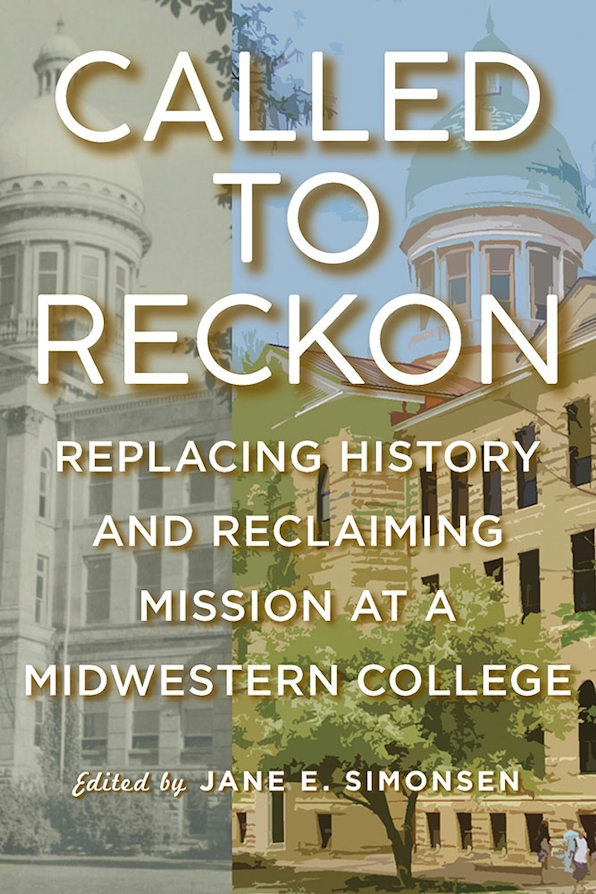
Called to Reckon is available from Southern Illinois University Press. Editor Jane E. Simonsen is a professor of history and women’s, gender, and sexuality studies and the Richard A. Swanson Chair of Social Thought at Augustana College. She is the author of Making Home Work: Domesticity and Native American Assimilation in the American West, 1860-1919.
Other contributors to the volume include: Steven Bahls, Robert Burke, Lizandra Gomez-Ramirez, Lauren Hammond-Ford, Sarah Lashley, Jason Mahn, Harrison Phillis, Mark Safstrom, Monica M. Smith, Christopher Strunk, and Andrea Talentino.